Congenital orthopaedic conditions refer to conditions related to the bones, joints, muscles and/or limbs that are present from birth. They can affect how your child sits, moves, grows and develops. Some issues can be seen straight away at birth whilst others will be noticed as your child begins to crawl, stand and walk.
With early recognition and correct treatment your child can be supported to manage their condition and develop in a healthy way. Speaking to the Best Orthopaedic Doctor in Bangalore can provide you with more information regarding your child’s condition and what treatment options are available.
What are Congenital Orthopaedic Conditions?
These are when there is an issue with the development of the musculoskeletal system whilst inside the womb. This can affect the shape, position, size and function of bones and joints.
Some conditions may have minimal effects and may just need to be monitored. Others will need physio, splints, casts or surgery depending on the diagnosis, age and severity of your child.
A paediatric orthopaedic assessment can help to identify these conditions.
Common Congenital Orthopaedic Conditions
There are many different congenital conditions which can affect your child’s bones, joints and limbs. Below are some common ones.
1. Clubfoot
This is when your child has one or both of their feet pointing inwards and downwards. Their foot can look twisted meaning it can be difficult to place their foot flat on the floor when learning to walk.
Treatment will typically start soon after birth using the Ponseti technique, this involves gentle manipulation and casting. Some children will also need a small operation to lengthen their Achilles tendon and wearing of splints.
2. Developmental Dysplasia of the Hip (DDH)
This is when your child’s hip joint has not developed properly. The top of the thigh bone will not sit properly into the hip socket.
Your child could have asymmetrical thigh creases, limited movement in their hip and/or asymmetrical positioning of their legs. Some children will be identified within their newborn check whilst others will be identified later.
Treatment may involve wearing a special harness, splints or an operation depending on the age of your child and severity of the condition.
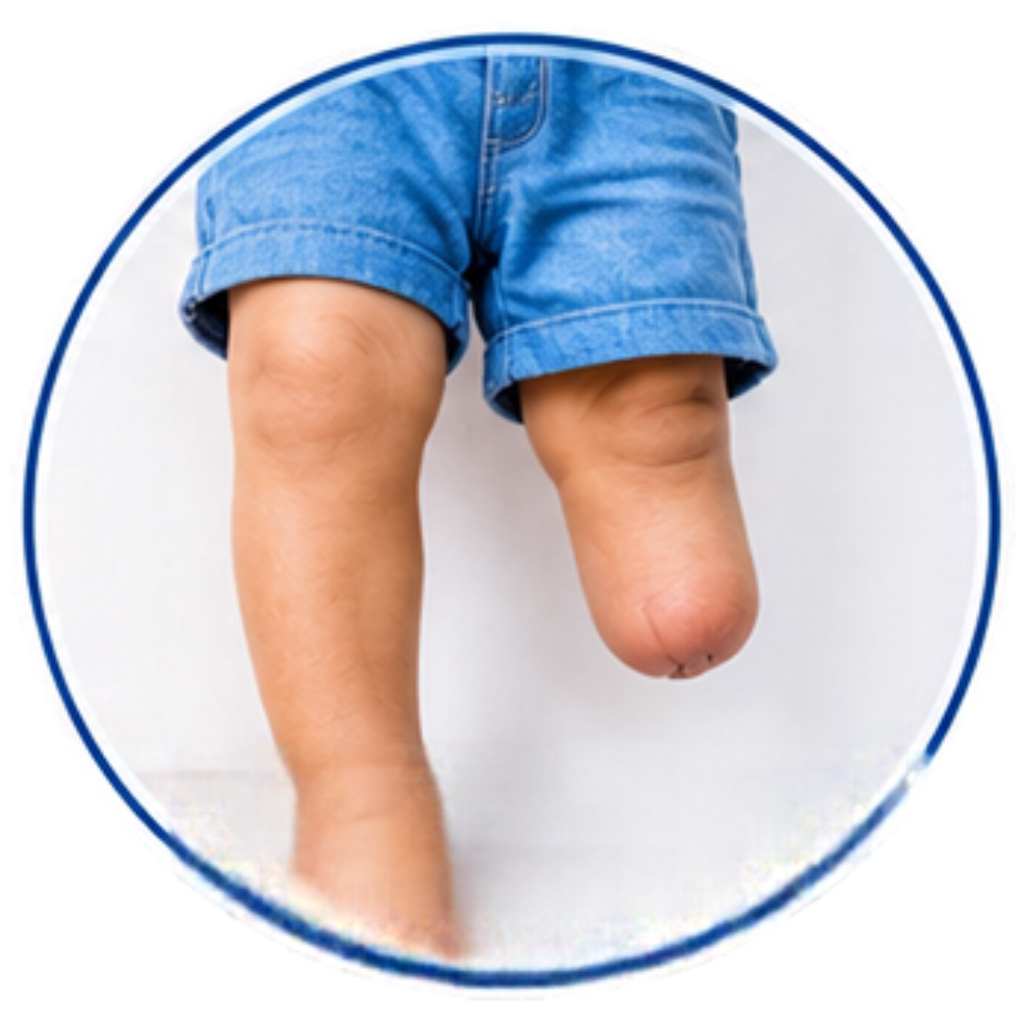
3. Congenital Limb Differences
Some children are born with differences in their arms or legs. This could mean they are missing bones, shorter and/or have differences in their fingers and toes.
Treatment will focus on improving function and enabling them to move well. This can involve rehabilitation, orthotics, prosthetics or reconstructive surgery in some cases.
4. Congenital Scoliosis
This is when the bones in the spine have not formed or separated properly whilst inside the womb. This can cause the spine to curve abnormally.
Some children can have mild curves which just need to be regularly monitored. Some children may need further treatment depending on how much their spine is growing and how much their curve is increasing.
5. Congenital Flatfoot
This is when your child has a low or no arch in their foot. Flexible flatfoot is common in younger children and usually gets better on its own.
However if your child has rigid flatfoot, pain and/or difficulties with walking, they may need further assessments. Treatment will depend on the cause and can involve wearing suitable shoes, exercise and/or other treatments.
Causes Congenital Orthopaedic Disorders
The cause of congenital orthopaedic conditions will depend on what condition your child has. Some can be caused by genetic factors whilst others can be due to bone/joint differences.
Possible causes could include:
- Genetic conditions.
- Abnormal bone/joint development whilst inside the womb.
- Certain environmental influences during pregnancy.
- Limited movement/positioning inside the womb.
- A mix of genetic and developmental factors.
In many cases the cause cannot be identified. Do not feel guilty for thinking your child has a congenital condition due to something you have done during pregnancy.
What Are the Early Signs Parents Should Watch For?
Identifying any abnormalities in your child can help you seek early treatment.
Signs to look out for include:
- Twisted looking feet.
- Asymmetrical legs/limbs.
- Limited movement in hips/joints.
- Abnormal curvature of the spine.
- Difficulties walking/standing.
- Movement asymmetry.
Not every difference is an inherent problem, however, and persistent and noticeable differences require an evaluation by a professional.
How Does the Best Orthopaedic Doctor in Bangalore Diagnose Congenital Orthopaedic Disorders?
Your child usually undergoes a physical examination for evaluation of their joints, limbs, muscle strength, posture, and development. The process is accompanied by taking an overview of their medical history.
Depending on the suspected condition, some investigations are performed which include the following:
- Ultrasound – The method is usually performed for evaluation of hip development in infants.
- X-ray – This procedure is used for the evaluation of bone structure, positioning, and deformities.
- MRI – This is sometimes recommended in case of some complex bone, joint, and spine conditions.
- Monitoring – Helps in tracking of your child’s development.
Best Orthopaedic Doctor in Bangalore advises on the suitable investigations depending on your child’s age, symptoms and physical examinations.
Treatment Options
Treatments depend on the condition and its severity. Commonly used treatments include:
- Physio – This is used to improve your child’s movement, flexibility, muscle strength, and development.
- Casts/Splints – They are used for conditions such as clubfoot and some hip conditions.
- Orthotics – Used for supporting correct positioning, stability, and movements.
- Surgery – Surgery can sometimes be used for some structural problems.
- Follow up visits – Regular visits to monitor your child’s progress.
Early intervention helps in the outcome of treatment however it depends on the condition.
Conclusion
Orthopaedic problems that your child is born with may include problems related to bones, joints, spine, and limbs. Disorders like clubfoot, hip dysplasia, congenital scoliosis and limb differences should be diagnosed and treated as individual cases. Early diagnosis will help your family know about the problem and begin the right treatment.
If your child shows signs of unusual bone and joint growth, get him or her evaluated by Dr. Akshay Shetty for an orthopaedic evaluation. Dr. Akshay Shetty is the Best Orthopaedic Doctor in Bangalore and he will evaluate your child’s condition and treat accordingly.